WCAG Compliance for GIS Content by Public Entities - Do You have a Plan?

Hi all! I was able to discuss this topic with a number of you at the conference earlier this week, but I figured it was important enough to discuss openly on the forum, as well.

As I’m sure everyone knows by now, there is a looming federal law that mandates that all publicly available web content by Governmental Entities must comply with the Web Content Accessibility Guidelines (WCAG) 2.1 (Level AA) by April of 2026. This, of course, includes any GIS Content that these organizations own/publish.

This legislation represents a challenge for my organization, as I’m sure it does for many of yours. We here at Peoria County have a lot of GIS Content maintained by a very small GIS Staff; our IT department has basically shifted the responsibility of getting our GIS Content compliant entirely onto us, and we currently don’t have a clear workflow/set of guidelines for achieving that.

At the ILGISA Conference earlier this week, I had the privilege of speaking with a wide range public-sector GIS Professionals (including from City/County Governments, State Organizations, Universities, and Regional Planning Commissions) about their plans for getting their existing/future GIS Content compliant with the new guidelines. Unfortunately, from these conversations, I really only got 3 genres of answers:

  1. A vague “Yeah, we’re working on it”
  2. “We’ve only just started looking into it”
  3. “We have no idea how we’re going to address this”.

The common through-line with all of these conversations was an understanding that there is clearly a lot of work to do, not a lot of time to do that work, and an unclear sense of where to really even start. This is a scary proposition, as this deadline is approaching very soon, and it feels like it hasn’t gotten the attention it deserves; failing to address this would mean having to revoke the public’s access to our GIS Content, or else opening ourselves up to lawsuits.

Through these conversations and my own research, I have found quite a few helpful resources that point us in the direction. In particular, the State of Colorado and the State of Minnesota have each put out extensive accessibility guidelines to which they hold their GIS Content. These are each great resources, and I highly recommend you read through them if you haven’t.

However, what there seems to be lacking for many of us is a clear understanding of what steps, specifically, we need to take to get our GIS content up to standard. For example, how do we ensure that every layer we publish has sufficient color contrast and low-complexity symbology for visually impaired users? How do we check that our ExperienceBuilder apps are supporting screen readers properly? How do we ensure that the alt-text we put on our PDF map is descriptive enough for the blind user?

Given all of this, I would like to pose 3 questions my fellow public-sector GIS Professionals, and you can chime in on any/all of them with any helpful information/discussions:

  1. Do you/your organization have a specific plan in-place for making your GIS Content WCAG compliant by April 2026? If so, what does that look like?
  2. Are there any resources related to accessibility you’ve been using that have helped in this process for you?
  3. (For GIS programs under the umbrella of a larger department): Does your department/organization have an organization-wide Strategic Plan for Accessibility? If so, what does that look like, and what kind of support are you getting from them in this process?

Any other relevant discussion is also welcome. TIA!

2 Likes

This a timely discussion topic for the forum. I am also in the same boat of not knowing where to start and look forward to hearing from others as well. I do know NSGIC (National States Geographic Information Council) has also completed a lot of work toward this and has some resources.

NSGIC Accessibility Working Group

3 Likes

Thanks for sharing the work NSGIC has done! I’ll be sure to read up on their accessibility content.

I was a bit surprised to see no sessions on Accessibility on this year’s conference Agenda, given how near the deadline is and how ubiquitously it will affect us. And I don’t mean that in a shame-y way, because my organization hasn’t really started on it, either! It just seems like a state-wide discussion and collaboration on this is overdue.

Perhaps this could be a candidate for a future ILGISA Webinar?

3 Likes

Absolutely! I’d be all for a sort of virtual panel / round table discussion. I’d also like to track down an org that’s already working on this, to get some perspective.

Pretty much everyone I’ve talked to about this is aware of the issue but hasn’t done anything yet.

1 Like

I think that’d be great! But yeah, my hope is that there are some organizations out there who at least have some sort of plan, if not some actual workflows/guidelines/checklists that they’ve made to aid them in this process.

Hey @MeaganB , anything to weigh in on what we’re doing? I don’t think this is really on our radar, is it?

Thanks for tagging me Josh!

This isn’t on our radar :grimacing: admittedly, partially on me, but also, county-wide it has NOT been discussed :melting_face:

Since we have been moving towards OpenStreetMap, I like to think the global community has already addressed this, but I will send a message out to get feedback.

maybe we create a Special Interest Groups to expand on this conversation?

I mean, I have the same sentiment about Esri. And true, Esri’s got a lot of guidance out there about accessibility in general, and WCAG compliance in particular. They’re trying to get their tools to conform to the guidelines, or at least give us options we can toggle.

When you get down to it, though, it’s still up to each individual organization to use those tools in a way that is accessible. It’s folks like us picking colors, writing (or not writing) alt text, choosing the layout, etc.

Who’s to blame?

Another possible wrinkle in this: we in GIS are often the ones building the map / app / dashboard, but at the behest of someone else. How should we handle, for instance, a request to modify a map or dashboard in a way that makes it non-conformant? Do we refuse?

In my opinion, this is where we can pass off the “blame” to the federal law. We still the build the requested product, following WCAG guidelines, and if the recipient asks for a non-conformant feature, we simply explain and/or share WCAG. If they’re quite grumpy/insistent about it, they’re welcome to go above your head, but you still have a federal law to back you up.

Ideally, your co-workers are also aware of the WCAG guidelines, so hopefully this isn’t a reoccurring issue.

got a great response over in OSMUS slack:

Your image of text would violate WCAG. :sweat_smile:

2 Likes

:joy::joy:

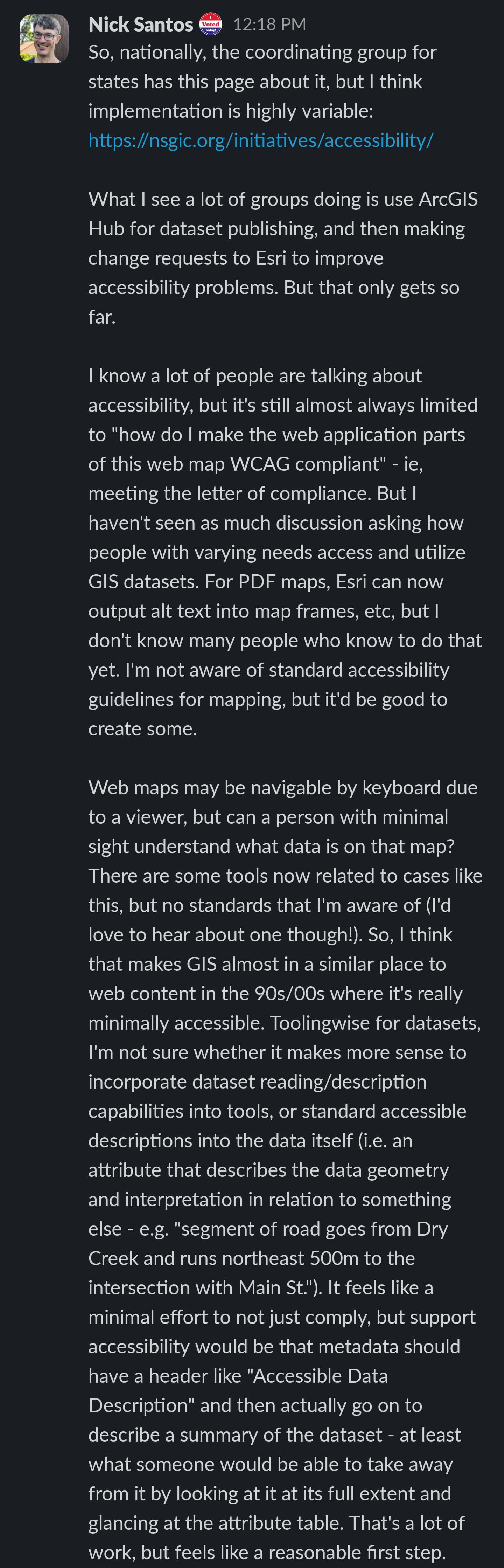
So, nationally, the coordinating group for states has this page about it, but I think implementation is highly variable: Accessibility | National States Geographic Information Council

What I see a lot of groups doing is use ArcGIS Hub for dataset publishing, and then making change requests to Esri to improve accessibility problems. But that only gets so far.

I know a lot of people are talking about accessibility, but it’s still almost always limited to “how do I make the web application parts of this web map WCAG compliant” - ie, meeting the letter of compliance. But I haven’t seen as much discussion asking how people with varying needs access and utilize GIS datasets. For PDF maps, Esri can now output alt text into map frames, etc, but I don’t know many people who know to do that yet. I’m not aware of standard accessibility guidelines for mapping, but it’d be good to create some.

Web maps may be navigable by keyboard due to a viewer, but can a person with minimal sight understand what data is on that map? There are some tools now related to cases like this, but no standards that I’m aware of (I’d love to hear about one though!). So, I think that makes GIS almost in a similar place to web content in the 90s/00s where it’s really minimally accessible. Toolingwise for datasets, I’m not sure whether it makes more sense to incorporate dataset reading/description capabilities into tools, or standard accessible descriptions into the data itself (i.e. an attribute that describes the data geometry and interpretation in relation to something else - e.g. “segment of road goes from Dry Creek and runs northeast 500m to the intersection with Main St.”). It feels like a minimal effort to not just comply, but support accessibility would be that metadata should have a header like “Accessible Data Description” and then actually go on to describe a summary of the dataset - at least what someone would be able to take away from it by looking at it at its full extent and glancing at the attribute table. That’s a lot of work, but feels like a reasonable first step.